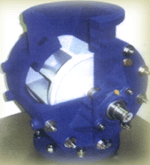
ROTARY
VALVES FEEDERS & AIRLOCKS
DIGIDALE
precision-built Rotary Valves are ued throughout industry....Wherever
precision volumetric feeding is required. Many standard models,
types and sizes are provided as per your specification & requirement. Because of our years of
experience in developing, testingand specifying rotary valves, we can help you choose the right valve for
any application.
AIR LOCK
FEEDERS
Rotary Air
Locks and Feeders are usually used to accomplish 3 basic tasks.
a) To feed material from bins or hoppers.
b) To deliver fines from the collector while sealing
against air loss.
c) And to feed material to pneumatic conveying line
against pressure.
DIGIDALE
Rotary Air Locks are built to work under a variety of conditions.
Three basic designs cover the tasks described above.
DROP THRU
TYPE
This is for
gravity discharge of materials from storage hoppers and bins into
receiving equipment or conveying lines.
SIDE ENTRY
TYPE
This design,
specially developed for plastic pellet handling and friable granular
materials which tend to disintegrate while handling in conventional rotors, finds
extensive application in the industry. This design is accompanied
with deflector plates and beveled rotor plates.
BELOW THRU
TYPE
This design
is always used with pneumatic conveying lines handling materials difficult
to discharge from the rotary Air lock vanes. This design occupies
less height and is advantageous, where space is a constraint.
ROTOR TYPES
STANDARD
ROTOR
This
standard 8 or 6 vane rotor is the most commonly used for handling materials
which do not stick to the rotor or have the tendency to disintegrate while handling.
BEVELLED
ROTOR
This is used
along with the Side Entry-Air-Lock for materials that have a tendency to
plastify and smear or pack between the housing and rotor tips. This
trailing age of the rotor trips are machined to a bevel, narrowing the land reducing frictional
drag.
ROTOR WITH
WEAR TIPS
This is a
standard rotor with replaceable bars of steel, brass or Teflon or any
other materials suiting the application. This is used where excessive wear of
the rotor edge is anticipated.
This Valves
are suitable for most dry dust such as Chemicals, Coffee, Detergents, Dry
foods,Drugs, Flour, Grains, Plastic, Starch, Sugar etc. Rotary Valves
manufactured by Digidaleare used as metering devices feeders and rotary air locks for dry
free flowing materials of varying size shapes, used with blenders, mixers, tanks, silos,
classifiers, dryers, collectors, hoppers, cyclones collectors, in virtually every industry.
SHALLOW
POCKET ROTOR
These are
reduced capacity rotors specially suited to handle sticky products which
do not discharge easily from conventional rotor. These are normally
accompanied with an anti stick coating to promote discharge.
HOW TO SPECIFY ROTARY
VALVES :-
Selecting the most
appropriate Digidale Rotary valves for your application is extremely
important.
The task may seem difficult because of the many types and sizes of
valves available....Drop-Thru, Side Entry, or Blo-Thru, choice of rotor designs; material of
construction, optional features and special design configurations. Actually the selection is
not difficult when the following steop-by-step procedure is used.
1. Product
Characteristics :- The product to be handled dictates the
first decision to be made, whether the conventional Drop-Thru Valve will meet the requirement
or if a Side Entry, or Bio-Thru Valve should be used.
A. Is it
powder, granules, Chips or flakes, cubes or pellets ?
Materials that are hard and
of large grain ( such as plastic pellets ) may jam a conventional
Drop-Thru Rotary Valve.
B. Is it
abrasive ?
Abrasive products may
require valves of special construction, or special plating at wear
surfaces. Rotor vanes may require adjustable tips and housings
equipped with inspectionports. Shrouded rotors and continuous purging may be required.
c. Does
it pack or smear?
Products
that are heat sensitive may pack or smear and require a valve with smooth interior surface, and sometimes, a coating
with low friction coefficient (such as Teflon). In some applications, the trailing edges of vane tips and sides are bevelled
to reduce friction.
2. Application –– Is the rotary valve for metering or non-metering
use?
Theapplication helps further define the model, size and rotor
type. Digidale Drop-Thru
Valves are calculated at 100% pocket fill for metering applications. Non-metering valves should be selected to have a minimum capacity
of 1.5 times the volume required. Side
Entry Valves operate at a maximum of 40% pocket fill.
3. Volume & Weight –– How much and how fast?
This
establishes the size rotary valve required, for either metering or
non-metering applications. First
determine: weight of product in kg per cubic mtr and volume required in cubic mtr per hour. Output capacity is computed based on the following.
CAPACITY
PER HR. (KGS.) = M3/HR.
PRODUCT WEIGHT KG/ M3
Valve
capacity is a function of pocket fill and valve speed. Valves for non-metering applications should be a minimum of 1.5
times required volume.
To
determine the Output Capacity Rating of a given valve use the following.
VALVE
CAPACITY (CU.MT./HR.) = ROTOR CAPACITY (CU.MT./REV.) x SPEED (RPM) x
60 (REV./HR.)
4.Differential
Pressure –– What will the differential pressure be across the rotor?
Digidale’s Standard Rotary Valves are designed for negative or
positive pressure. For requirements involving lower leakage, leakage,
special rotors and seals, and tighter tolerances may be required.
5. Interface
–– What are the flange size requirements?
Often,
the rotary valve is selected based on inlet and outlet sizes. Digidale Rotors. Types B and C, are partially filled for applications requiring small
throughput, but set size of inlet and outlet. Where
greater throughput is required without increasing the flange-to-flange
dimension. Style 2. Double-Length Valves are often specified.
6. Operating
Temperatures –– Will high operating temperatures be a factor?
Digidale standard Rotary Valves are designed for operation at suitable
temperature. When higher temperature use is specified, special high-temperature
bearings and packing are required, stress relief employed and tolerances reviewed.
|